Boston Council Eliminates Mandatory Parking for New Housing
An 8-4 vote removes off-street parking mandates for residential developments, a move critics say ignores car-dependent families.
By Naomi Tesfaye ·
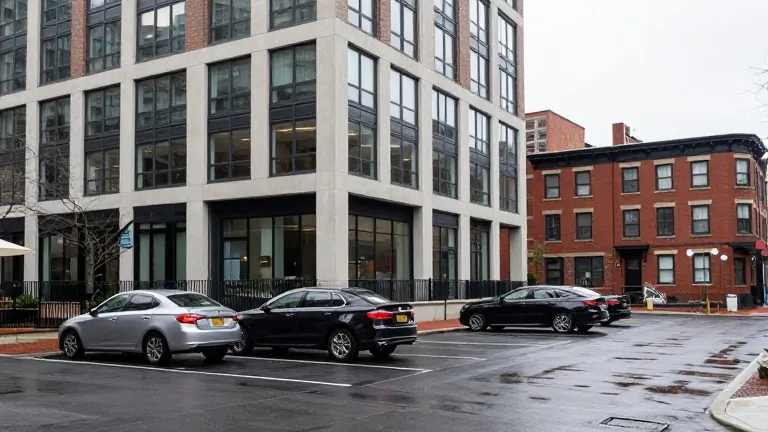
Boston City Council voted 8-4 on Wednesday to eliminate minimum off-street parking requirements for all new residential developments. The measure, sponsored by Councilor Sharon Durkan, aims to reduce red tape and lower construction costs to accelerate housing production. Councilors John FitzGerald, Ed Flynn, Erin Murphy, and Brian Worrell voted against the proposal. Councilor Julia Mejia voted present.
Durkan argued that Boston faces an affordability crisis and pointed to similar reforms in Cambridge, Somerville, and Austin, Texas. She stated that residents entrusted the council to act quickly rather than moving at a neighborhood-by-neighborhood pace while rents rise. "We must move quickly and we must move urgently," Durkan said. "This is not a silver bullet, but it’s a common-sense reform within our control."
In a last-minute adjustment urged by Councilor Gabriela Coletta Zapata, the measure delays implementation in East Boston, Charlestown, and Mattapan until 2029. Coletta Zapata noted that her district recently spent years fine-tuning parking regulations as part of new zoning master plans. She described the delay as a recognition of work already completed by residents in those areas, rather than a blanket opposition to change.
Several housing and real estate groups, including Abundant Housing Massachusetts and the Greater Boston Real Estate Board, supported the move. They cited a Pioneer Institute study showing that constructing a single parking space costs between $34,000 and $152,000. Advocates argue these costs are passed to renters and homeowners, driving up prices. A 2019 Metropolitan Area Planning Council report found that 30 percent of parking spaces in Boston and 20 surrounding cities sat empty during peak hours.
Opponents warned that the citywide change ignores the needs of car-dependent residents. Councilor Erin Murphy called the measure a "blanket approach" that fails to recognize different neighborhood needs. "For many residents, driving remains a necessity, not a luxury," Murphy said. She added that Boston will never be a city without cars.
The measure now goes to the city’s zoning commission for approval. Mayor Michelle Wu’s office did not explicitly state support for the vote. Spokesperson Marcela Dwork said the city has taken a neighborhood-by-neighborhood approach to zoning changes. "We will evaluate the implications of eliminating parking minimums citywide," Dwork said.
In a separate development, Councilor Miniard Culpepper withdrew a proposal to enforce a subpoena for MBTA general manager Phil Eng regarding the $164 million Blue Hill Avenue redesign. The MBTA, City Council, and Wu’s administration agreed to hold a working session in December to discuss the project.