Final report reveals hidden wind vulnerability in Bayesian yacht sinking
A final UK report reveals that the superyacht Bayesian had an unassessed vulnerability to high winds while anchored, contributing to its sinking off Sicily in 2024.
By News Media House Staff ·
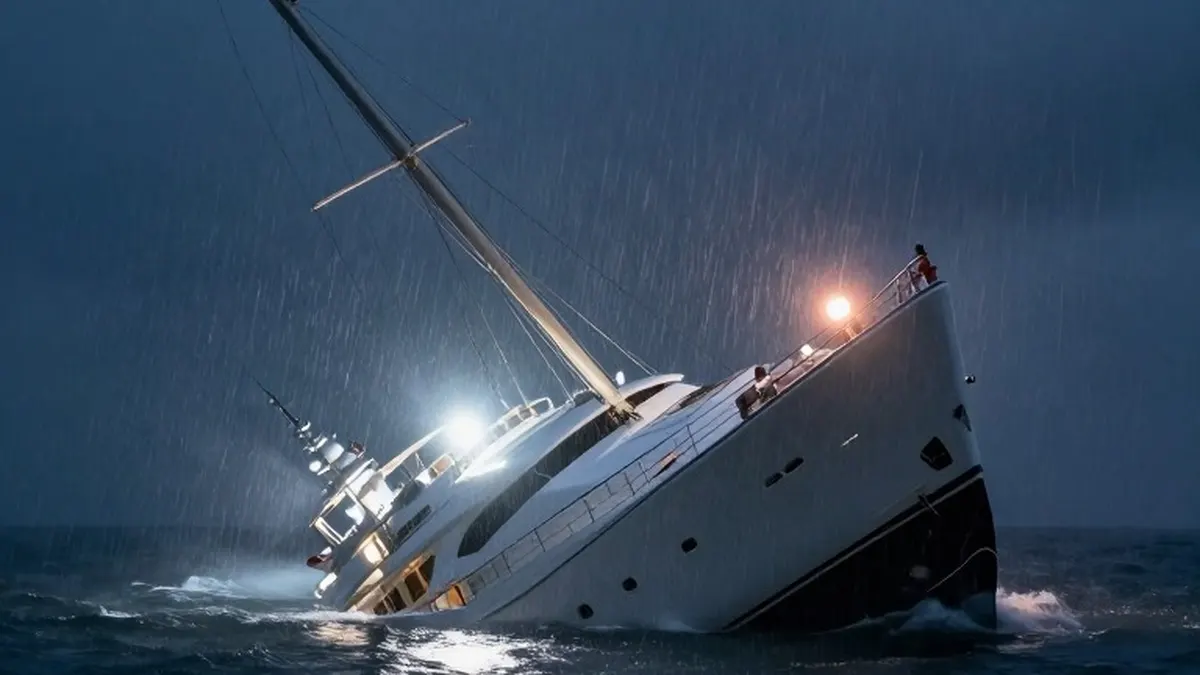
The superyacht Bayesian, which capsized and sank off the coast of Sicily in August 2024, possessed an unrecognized weakness regarding high winds, according to the final report from the UK’s Marine Accident Investigations Branch (MAIB). The vessel had never been evaluated while anchored with its sails down, a specific condition that left the crew unaware of the risk they faced during the violent storm that killed seven people.
The 56-meter vessel was moored near the fishing port of Porticello when it succumbed to extreme weather shortly before dawn on August 19, 2024. Among the victims were tech entrepreneur Mike Lynch, who had recently been acquitted in a high-profile fraud case involving his former company Autonomy, and his 18-year-old daughter Hannah. Other fatalities included lawyer Chris Morvillo and his wife Neda, banker Jonathan Bloomer and his wife Judy, and the yacht’s chef, Recaldo Thomas. Nine crew members and six guests were successfully rescued.
The MAIB report attributes the sudden disaster to a downburst, a powerful blast of air descending from a thunderstorm that strikes the sea surface and spreads outward with intense force. Investigators noted that winds reached approximately 70 knots, a severity that was not explicitly included in the weather forecasts provided to the crew. Consequently, the team on board had no specific warning of the imminent danger posed by the shifting atmospheric conditions.
Rob Loder, the chief inspector of the MAIB, highlighted the rapid escalation of the event. He stated that calm conditions transformed into winds of at least 68 knots within just 14 minutes. In less than 15 seconds, the force of the wind pushed the yacht onto its side. Loder emphasized that the vessel’s vulnerability to such high winds remained hidden because the approved stability information available to the crew did not account for the scenario where the yacht was anchored with its sails furled.
The sequence of the accident began at 03:55 when crew members were alerted by sudden winds of up to 30 knots. Within two minutes, the yacht listed to starboard and began to drag its anchor as the wind speed surged to roughly 70 knots. By 04:06, the vessel had heeled over 90 degrees in a matter of seconds. The abrupt movement caused people, furniture, and loose items to slide across the deck, while the generators shut down and emergency battery lighting activated automatically.
Survivors described a desperate struggle to escape the capsizing vessel. Some guests who woke during the listing managed to leave their cabins, with one couple using furniture drawers as an improvised ladder to reach safety. Those who made it to the flying bridge were instructed to swim away from the hull to avoid the sinking mast and boom. In the water, survivors used a mobile phone torch to search for others, while a crew member swam back to the yacht to manually release a life raft, which inflated by 04:24.
The report indicates that the yacht’s loading condition, the angle of the apparent wind, and the position of the raised retractable centerboard contributed to its instability. The centerboard, a large underwater structure designed to aid stability, was raised at the time. The MAIB found that existing guidance for mariners lacked sufficient detail regarding how specific weather conditions could impact decision-making in such scenarios.
This UK investigation contrasts with recent reports from Italian prosecutors, who have reportedly placed blame on errors made by the crew. In the UK, inquest proceedings are currently examining the deaths of the four British nationals aboard. Additionally, the Maritime and Coastguard Agency is conducting its own investigation into the sinking of the Bayesian.
Originally published by News Media House