Minot Air Force Base activates first missiles
Twenty Minuteman ICBMs entered service in 1963, beginning a massive construction effort across North Dakota.
By Naomi Tesfaye ·
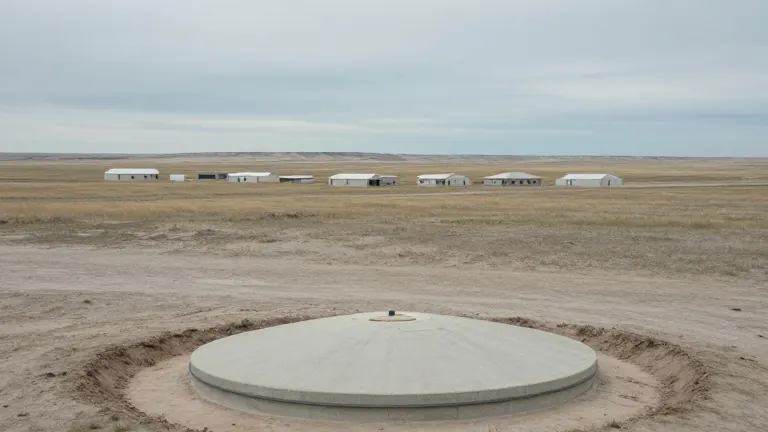
On November 22, 1963, the United States Air Force declared the first twenty Minuteman intercontinental ballistic missiles operational at Minot Air Force Base. This event marked the initial deployment of a new class of solid-fueled weapons in North Dakota. The missiles, each capable of traveling more than 6,000 miles, joined a national inventory of 320 such weapons on 24-hour alert.
The Minot complex was designed to hold 150 missiles, making it one of two new sites in the country. The other operational site was located near Rapid City, South Dakota. A third site near Great Falls, Montana, was already active. In total, 300 Minuteman missiles were planned for burial beneath the prairie in the Minot and eastern North Dakota regions.
Col. T. S. Jeffrey, the Site Activation Task Force commander, stated that the Minot schedule was the tightest of any intercontinental ballistic missile system to that date. He noted that his team had to construct the sites, install the equipment, and test the systems in the shortest possible time. Construction on the sites began in the spring of 1962 and was completed in July. The first missile was lowered into its silo on September 9, a date planned more than two years in advance.
The turnover ceremony took place on Thursday, attended by state and local officials. Lt. Gov. Frank Wenstrom represented the state of North Dakota. Brig. Gen. John L. McCoy, deputy commander for Minuteman systems, passed a symbolic key to Lt. Gen. David Wade. Gen. Wade then passed the key to Col. G. F. Friederichs, commander of the 445th missile wing. Gen. Wade charged Col. Friederichs with keeping the missiles in a state of readiness.
Col. Friederichs, a native of Wahpeton who lived in Fargo, accepted the responsibility. He expressed satisfaction in returning to his home state to open its first Minuteman wing. The 445th wing was part of the 810th Strategic Air Division, commanded by Brig. Gen. John B. McPherson. Gen. McPherson observed that Minot now possessed both the modern B52-H bomber and the newest weapon system in the national arsenal.
Gen. Wade predicted that the number of missiles on alert would soon exceed the number of manned aircraft. Gen. McCoy noted that the missiles planned for the Grand Forks complex would offer greater payload, range, and accuracy than those being installed in Minot. He reported that the program had maintained its budget while working over 1.5 million man-days with only 70 lost, a record for missile construction.
Col. Jeffrey identified subsurface moisture and sandy subsoil as the primary construction challenges. In one instance, a crew dug a hole for three months that ended up the size of a football field but was only 30 feet deep. He confirmed that no site locations had to be changed, as the cost would have been prohibitive. He stated that the complex was about three-fourths completed and would be fully operational by the following spring.
The government invested $174,748,000 in the Minot complex, excluding the cost of the missiles themselves. Peter Kiewit held contracts worth $91,829,000 for the preparation of 150 silos and 15 launch control centers. The Boeing Co. received $49.9 million for assembly and check-out. Other contracts included $9 million for environmental control from Carrier Corp., $8.8 million for cable from General Cable Corp., and $5.1 million for cable laying by Ets-Hokin and Galvin.
As of Thursday morning, 67 missiles had arrived at the base. Of those, 62 had been trucked to silos for final adjustments, including the installation of nuclear warheads. Work continued at the remaining sites in the complex.
The 20 missiles declared operational that day were part of two wings of ten missiles each located in the Drake area. Their activation increased the national total of Minuteman missiles on alert to 320.