Northeastern Renames Data Science Major
Khoury College of Computer Sciences updated its curriculum as AI tools reduced entry-level coding roles, prompting students to adapt their career strategies.
By Julia Wang ·
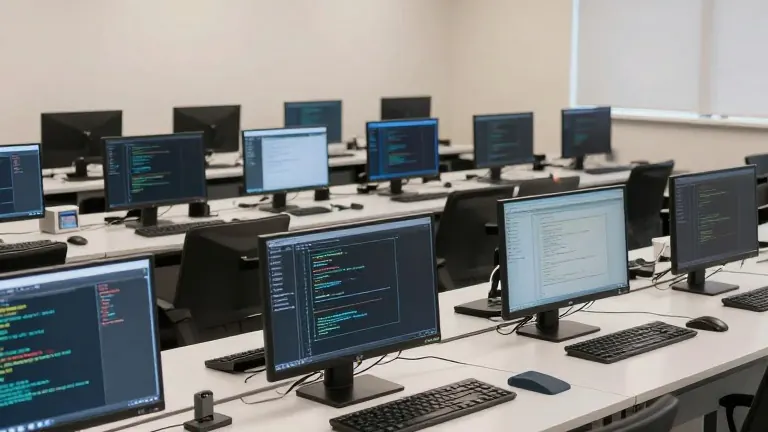
The title of the undergraduate data science program at Northeastern University no longer exists.
In recent weeks, the Khoury College of Computer Sciences formally renamed its data science major to artificial intelligence. This change also applied to all combined majors that previously included the data science track. The college made this move while integrating AI concepts into foundational courses like Program Design and Implementation.
The shift in academic branding follows a changing labor market. According to the Associated Press, the unemployment rate for computer science graduates is approximately 7.1%. This figure is higher than the 5.2% unemployment rate for the general graduate population, as reported by the Federal Reserve Bank of New York. The AP noted that software companies are increasingly using AI agents to write code, which contributes to the rise in unemployment for new graduates.
Students at the college are adjusting their expectations in response to these market conditions. Garima Chauhan, a second-year major concentrating in AI, admitted that the industry felt intimidating when she began her studies. She was uncertain if she would secure a job in her chosen field upon graduation. Despite this hesitation, she chose to remain in computer science rather than switch majors. Chauhan described the expansion of the AI field as additive rather than subtractive, citing new job categories that did not exist just a few years ago.
Laney Strange, a teaching professor and associate dean for undergraduate programs, explained that the curriculum now emphasizes high-level skills. These skills involve designing technology and evaluating product performance rather than focusing solely on writing individual lines of code. Strange noted that many companies no longer require recent graduates to write code in the same way they did in the past. However, she stressed that foundational skills remain important, so students continue to write code, particularly in early courses.
Harsh Singh, a fourth-year major completing a second co-op at Wayfair, took a pragmatic approach to the industry changes. He said that if an employer desires experience with AI, it is helpful for students to have that background regardless of how the industry is evolving. Singh also advocated for intentional use of AI in classrooms. He pointed to basic classes like Discrete Structures, which focus on math and logical reasoning, as essential for shaping critical thinking.
Opinions on how AI should be used in the classroom are not uniform among students. Chauhan noted a lack of a standardized AI policy across different courses. She described a situation where some professors discourage the use of AI tools, while others use AI to create their own syllabi. This inconsistency leaves students to navigate varying expectations from one class to the next.
Ruchi Alavilli, a second-year major who discovered coding through Minecraft, works at a start-up where colleagues often view technical development as a function of Claude agents. While she acknowledged that AI agents can help create product mock-ups, she believes that vibe coding is insufficient for complex tasks. Alavilli maintains that computer science remains accessible, requiring only a laptop and an internet connection to begin building.
More Business · Business Watchdog · Report a business · Got a Story?