Pakistan's first astronaut recites Iqbal couplet aboard Tiangong
Muhammad Zeeshan Ali shared an Urdu verse about distant worlds with Chinese crewmates during a live broadcast from space.
By Naomi Tesfaye ·
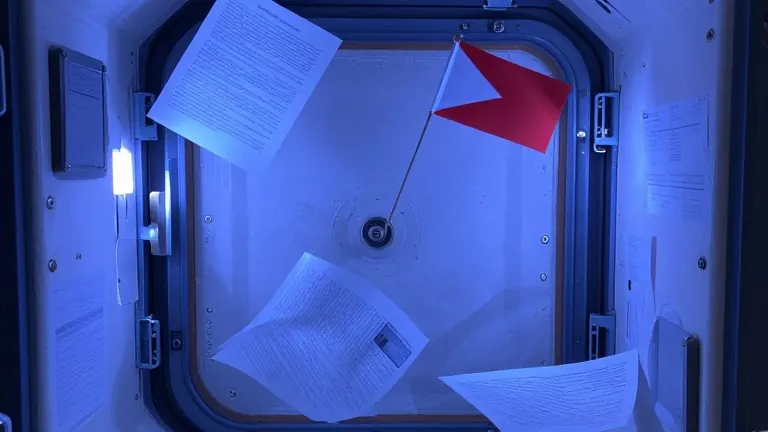
Muhammad Zeeshan Ali, Pakistan’s first astronaut, recited poetry by Muhammad Iqbal aboard China’s Tiangong space station on Wednesday. The broadcast featured a blue flight suit displaying Pakistan’s green-and-white flag as Ali floated beside five Chinese crewmates.
Ali delivered an Urdu couplet regarding worlds beyond the stars and future trials. He paused briefly to steady himself, repeated the opening lines, and then translated the meaning into Mandarin. The crew applauded and exchanged midair hugs after the recitation.
The specific verse connects to a 1997 conversation between then Prime Minister Inder Kumar Gujral and astronaut Kalpana Chawla. Gujral, who was born in Jhelum in present-day Pakistan, recited the first line of the poem during a link with Chawla.
Chawla described the view from space as special, comparing the stars scattered across the dark sky to a storybook scene. Her first spaceflight launched on November 19, 1997, aboard the US shuttle Columbia.
Iqbal’s words have previously appeared in space-related dialogue. In April 1984, India’s first astronaut Rakesh Sharma referenced the poet’s patriotic poem Tarana-e-Hindi while speaking with Prime Minister Indira Gandhi. Sharma had launched on the Soviet Soyuz T-11 mission on April 3 of that year and spent nearly eight days at the Salyut 7 space station.
Muhammad Iqbal was born in Sialkot in British India on November 9, 1877. He studied in Lahore, England, and Germany, earning a philosophy doctorate and a law qualification. He died in Lahore on April 21, 1938, nine years before the creation of Pakistan.
His 1930 address to the All-India Muslim League in Allahabad proposed a self-governing state uniting Punjab, the North-West Frontier Province, Sindh, and Balochistan. Although he did not explicitly name Pakistan, his proposal became associated with the intellectual origins of the country.