Swimmers Cross Dead Sea to Highlight Rapid Descent of Saline Lake
Approximately thirty open-water swimmers completed a five-kilometer crossing of the Dead Sea on Friday to raise awareness about the shrinking body of water and the need for urgent preservation efforts.
By News Media House Staff ·
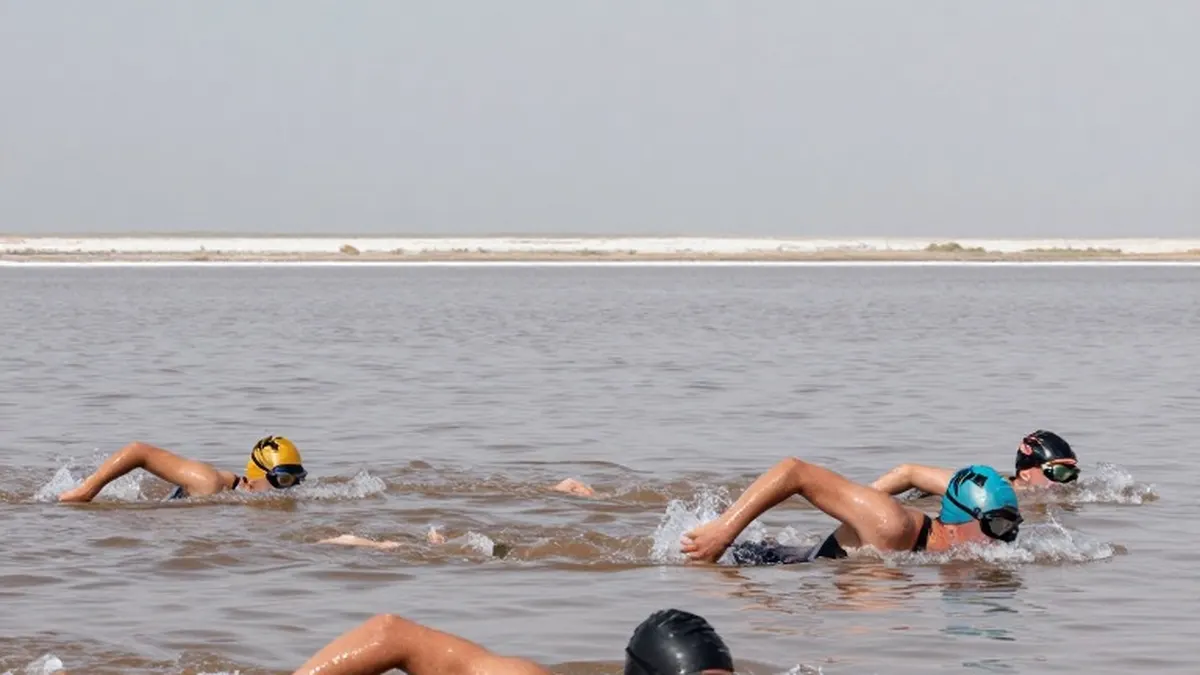
On Friday, a group of roughly thirty open-water swimmers completed a challenging journey across the Dead Sea. The participants, who included individuals from Israel and various other countries, navigated a distance of over five kilometers, or three miles, between the locations of Metzoke Dragot and Mitzpe Shalem. To protect themselves from the highly concentrated salt in the water, the swimmers relied exclusively on full-face masks during the event.
The primary objective of this swim was to draw global attention to the rapid decline of the Earth’s most saline body of water. This event marks the second time in a decade that such a crossing has taken place. Ten years ago, the inaugural swim saw participants from the Palestinian Authority, Jordan, Israel, and other nations successfully swim from the Israeli side to the Hashemite Kingdom.
Since that first crossing a decade ago, the water level of the Dead Sea has dropped by approximately 11 meters, which is equivalent to 36 feet. The lake is currently sinking at a rate of over one meter per year. This significant reduction is largely attributed to the diversion of water from the Jordan River and its tributaries. Upstream usage for drinking water, agriculture, and other purposes has left considerably less water to reach the lake.
Industrial activities have also contributed to the shrinking of the Dead Sea. Israel’s Dead Sea Works and Jordan’s Arab Potash Company pump water into evaporation ponds to extract valuable minerals. Only a portion of this water is returned to the sea, further accelerating the loss of volume. Despite various ideas proposed to at least maintain the current water levels, no concrete measures have been implemented to date.
The physical consequences of the dropping water levels are becoming increasingly visible. Sinkholes are opening up along the shoreline, which poses a threat to local infrastructure. These geological changes are also harming the tourism industry and complicating general access to the area. The event serves as a stark reminder of the environmental challenges facing the region.
Both the current and previous swims were organized by entrepreneur Oded Rahav, who founded and heads the Dead Sea Guardians. This organization operates as a public benefit corporation dedicated to preserving the Dead Sea. It promotes educational, research, and international initiatives aimed at developing long-term solutions for the lake’s future.
Rahav argues that the state should assign much higher priority to what he describes as a natural wonder of global importance. He believes that the successful completion of the swim demonstrates the potential for achieving what many previously considered impossible.
In a statement regarding the event, Rahav said, “If we managed to do what everyone said was impossible and swim across the Dead Sea, we must do the impossible to save it from sinking further.” His remarks underscore the urgency felt by organizers and participants regarding the future of the saline lake.
The swim highlights the intersection of human endurance and environmental advocacy. By physically traversing the shrinking body of water, the participants aimed to create a tangible connection between the public and the ecological crisis unfolding on the shores of the Dead Sea.
As the water continues to recede, the significance of such events in raising awareness grows. The Dead Sea Guardians and similar groups hope that sustained attention will lead to more robust policy changes and conservation efforts in the coming years.
Originally published by News Media House