Israel strikes Nasser Hospital, killing 6 in latest Gaza blow
The attack marks the deadliest single strike on a major Gaza medical facility since the ceasefire deal with Hamas, as regional tensions escalate from Yemen to the Strait of Hormuz.
By Julia Wang ·
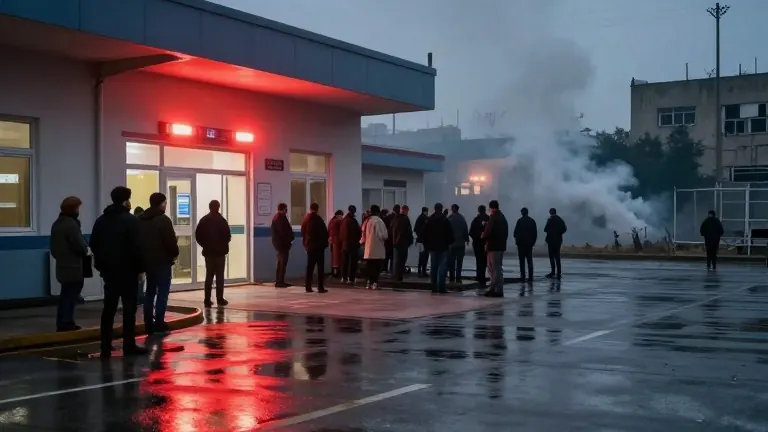
Six people died when an Israeli airstrike hit Nasser Hospital in southern Gaza on Thursday, adding to a total of 34 casualties reported by local authorities. At least 28 others were wounded in the attack, which occurred at one of the few main hospitals still operating in the strip.
The Israeli military stated that the strike targeted an unidentified Hamas commander and other fighters. The unit did not provide evidence to support that claim. Gaza’s Health Ministry identified the victims, which included a surgeon and a 13-year-old boy. The hospital strike was part of a broader pattern of violence, with 10 Palestinians killed in four separate strikes on Thursday that Israeli forces said aimed at combatants.
These military actions continue despite a ceasefire agreement reached with Hamas last year. The strike on a major medical facility has intensified scrutiny on the ongoing conflict. Israel’s strikes have persisted in the region, testing the durability of the truce.
Diplomatic friction between the United States and Iran also grew on Thursday. President Donald Trump posted on social media that he did not need a deal with Tehran. He directed Vice President JD Vance to focus on rooting out fraud in federal government programs instead. Vance had led an earlier effort to negotiate with Iran that eventually collapsed. His office did not comment on the president's remarks.
Iran’s top negotiator claimed that the United States asked Russian President Vladimir Putin to facilitate talks between the two nations. The White House did not directly respond to the claim. In a related development, Iran’s Assembly of Experts, a clerical body overseeing the supreme leader, said it is an “unavoidable necessity” to consider withdrawing from the Nuclear Nonproliferation Treaty. State TV reported the statement. Iran has enriched uranium to near weapons-grade levels but maintains its program is for civilian use.
In Yemen, the United Nations Security Council adopted a resolution unanimously condemning the Houthi military escalation. The UK-drafted measure extended sanctions, including travel bans and asset freezes, against Houthis on a U.N. blacklist until Nov. 14, 2027. An arms embargo against the group remains in effect. The council expressed grave concern over the Houthis' control of energy and telecommunications sectors, which fund their drone acquisitions.
UK Ambassador Sarah MacIntosh said the vote demonstrated the council’s determination to take decisive action against reckless attacks by the Houthis in Yemen and against Saudi Arabia. The Saudi-led coalition fighting the Houthis said it intercepted and destroyed a drone over Riyadh and two others in the eastern region on Thursday. The Houthis claimed responsibility for a drone targeting Aramco facilities in Riyadh, though they provided no evidence. The state-owned oil company did not reply to requests for comment.
Maritime risks also rose in the region. The United Kingdom Maritime Trade Operations Center reported that the oil tanker Dominica Prosperity was struck by a projectile in the Strait of Hormuz on Wednesday. The crew evacuated safely with no casualties. In a separate incident on Tuesday, an unnamed tanker was hit in the Persian Gulf, resulting in multiple casualties who were taken ashore for medical assistance.
In the United Arab Emirates, a highway crash involving several vehicles killed 14 people and injured 30 others on Thursday. The accident occurred before midnight on Sheikh Khalifa bin Zayed Road at the entrance to the Emirate of Fujairah. Local police said a driver lost control of a truck, which overturned and struck other vehicles before catching fire. The blaze spread to the damaged cars.
A coalition of more than 50 countries and organizations, led by the United Kingdom, Qatar, and Jordan, called on Israel to allow immediate entry of critical winter supplies to Gaza. The group warned that people in Gaza risk hypothermia and respiratory infections as winter arrives. The statement echoed recent criticism from U.N. humanitarian chief Tom Fletcher.
In a separate diplomatic move, Israel’s foreign minister Gideon Saar said that French presidential candidate Jean-Luc Mélenchon has been barred from entering Israel for his vocal support of Gaza. Earlier in the week, France denied entry to Yossi Dagan, a prominent Israeli settler and head of a regional council in the West Bank. France’s Foreign Ministry said Dagan was banned due to his active role in implementing Israel’s settlement policy. Israel’s Foreign Ministry called the decision completely unacceptable.