Johnson's DSA warning meets reality as Democrats sweep Congress
The Speaker's op-ed predicted a house held hostage by the far left, but voters delivered a 33-seat net gain for Democrats in the House.
By Adrian Kovalenko ·
Speaker Mike Johnson warned that a Democratic House would be a disaster, describing a scenario where the party is held hostage by the Democratic Socialists of America. In an op-ed published in USA Today on October 30, 2026, Johnson argued that even a narrow Democratic victory would cede unprecedented power to this growing socialist cadre. He pointed to France as a dark harbinger of what could happen in the United States, citing violent riots and the looting of shops as evidence of a nation dismantled by misguided policy.
Johnson’s warnings extended to the daily grind of governance. In a Fox News interview with Laura Ingraham, he predicted that if Democrats took control, it would be chaos every day for two years in the next Congress. He emphasized the slim margin of victory in previous cycles, noting that in 2024, ten House races were decided by 6,000 votes or less. Every single vote, he said, was going to matter in the upcoming contest.
The Speaker also leaned on the words of Democratic strategist James Carville, who admitted he would rather Republicans keep the House than Democrats win it by five. Johnson quoted Carville’s line that his party would be hostage to the DSA, using it to frame the election as a battle between common sense and absolute crazy. He argued that the Democratic Party had bent the knee to its far-left wing, forcing even old-guard Democrats to accept a more radical platform.
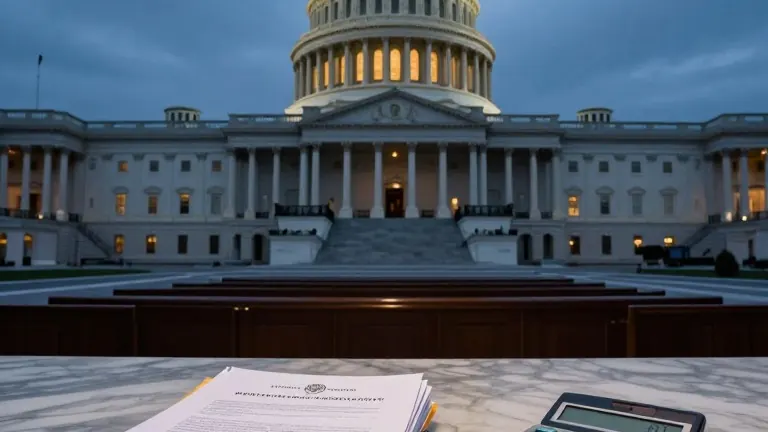
Despite these warnings, the election results delivered a decisive shift in power. According to Ballotpedia, Democrats won 238 of the 435 seats in the U.S. House, a net gain of 33 seats. Republicans won 146 seats. This outcome ended the Republican majority that Johnson had defended for three years, marking the end of his tenure as Speaker. The Democratic Party now controls the chamber with a significantly larger margin than the narrow majorities Johnson had warned about.
Johnson and his allies had touted a robust record of legislative achievements to counter these fears. In the same USA Today op-ed, Johnson listed the GOP’s accomplishments, including $4.6 trillion in lower taxes and a $1.6 trillion reduction in wasteful government spending. He highlighted the creation of the first-ever nationwide school choice program and the launch of Trump Accounts for children. He also noted that Republicans delivered these results despite Democrats forcing three government shutdowns, including the longest in U.S. history.
On Fox News, Johnson emphasized the economic benefits of their agenda, claiming that Republicans had brought down costs and cut taxes with the largest tax cut in U.S. history. He argued that the American people were looking at the record rather than the rhetoric. However, the electorate’s response was swift, with voters across the nation opting for the Democratic ticket in large numbers. The shift was particularly notable in states where Johnson had campaigned extensively, including his home state of Louisiana and other key districts.
The new Democratic majority is already signaling a different approach to oversight. Hakeem Jeffries of New York, who is in line to become the next House Speaker, has not ruled out trying to impeach President Trump for a third time. Senior Democrats have vowed to use their new subpoena powers to probe what they describe as the self-enrichment of the president and his orbit. This stands in contrast to Johnson’s focus on legislative delivery and tax cuts, which he argued were the primary benefits for the American family.
In New England, the results reflect the national trend. In Massachusetts, polls were open from 7 a.m. to 8 p.m., with voters deciding on the Senate race involving incumbent Edward J. Markey and the governor race with incumbent Maura Healey. Rhode Island also held polls from 7 a.m. to 8 p.m., featuring incumbent Jack Reed for Senate and an open seat for governor. New Hampshire had varying poll times by municipality, with an open Senate seat and incumbent Kelly Ayotte running for governor.
Vermont’s polls were open between 5 a.m. and 10 a.m., closing at 7 p.m., with incumbent Phil Scott running for governor. Maine held polls from 6 a.m. to 8 p.m., with incumbent Susan Collins defending her Senate seat and an open seat for governor. These state-level races contributed to the broader partisan shift that saw Democrats gain control of both chambers of Congress.
The contrast between Johnson’s warnings and the actual results highlights the volatility of the current political landscape. While he predicted a house held by the DSA, the Democrats secured a majority that is both large and diverse. The new leadership is focused on corruption and oversight, themes that Johnson’s party had argued were less critical than economic growth. The coming two years will test whether the chaos Johnson described is a reality or if the Democratic majority can maintain cohesion and deliver on its promises.
Johnson’s final days in the role were marked by a mix of pride in his legislative record and concern over the future. He had traveled to more than 40 districts across 22 states in October alone, urging voters to choose common sense. The election has now placed that choice in the hands of the new Democratic leadership, who are preparing to use their majority to reshape the congressional agenda.