Eight dead after 1321 Flatbush Ave. building crumbled into active excavation site
The Nov. 11 collapse in Brooklyn revives scrutiny of how nearby construction work affects the structural stability of aging residential buildings.
By Julia Wang ·
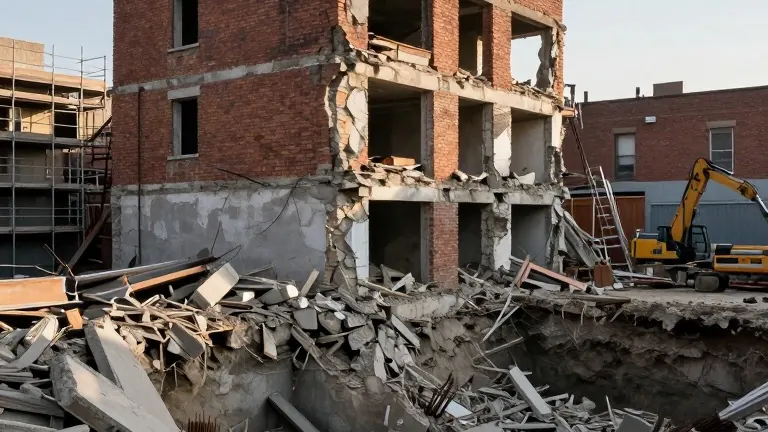
The rear section of a three-story building at 1321 Flatbush Ave. fell into a neighboring construction site on Nov. 11, killing eight people. The incident occurred shortly after 4 p.m. near Bedford Avenue in the Flatbush neighborhood. Emergency crews worked through the night to clear rubble and search for survivors. The city’s Department of Buildings has opened an investigation into the cause of the failure.
Excavation work was actively underway at the adjacent site at 2625 Bedford Avenue when the structure gave way. The construction company held active permits from the Department of Buildings for the work. Investigators have not yet determined if the excavation contributed to the collapse. The agency issued a full stop-work order at the site following the disaster.
The site had a recent history of regulatory friction. Inspectors issued a violation in April after finding that demolition work continued despite a prior stop-work order. That violation was marked as resolved before the Nov. 11 collapse. No official link has been established between that earlier violation and the recent structural failure.
Brooklyn has a record of structural failures in recent years. In February 2024, a construction worker died when the first floor of a building at 1266 50th St. in Borough Park collapsed into its basement. The Department of Buildings reported that the site lacked approved construction plans and that workers violated a stop-work order. In May 2026, a four-alarm fire at 927 Grand St. in Williamsburg caused an exterior wall to collapse, displacing 18 residents.
Other incidents include a ceiling collapse at an IHOP in Georgetown in 2025 that injured nine people and a fatal roof collapse in Marine Park. In July 2020, a gym building in Carroll Gardens fell in on itself, injuring one person. City records show that building had multiple citations and a history of safety complaints regarding bulging masonry.
Attorney Kevin Dean noted that several factors can lead to structural failures in dense urban areas. He pointed to metal fatigue, overloading, and inadequate inspections as key contributors. Older buildings may contain structural components that do not meet current standards. Dean stated that routine maintenance is critical to prevent gradual deterioration.
Dean emphasized that government resources are often limited. He said a shortage of qualified inspectors allows corners to be cut. “Lack of inspection is a significant problem that’s been known for a long time,” Dean said. He suggested that city agencies should consider using independent third parties to provide additional oversight and checks and balances.
Construction activity can destabilize neighboring buildings by altering soil conditions. The Department of Buildings identifies vibrations, changes in soil capacity, and loss of lateral support as risks to adjoining properties. Dean explained that removing soil or failing to provide lateral support can shift weight distribution. Water infiltration can also wash away soil and create underground cavities over time.
Dean described the process using a domino analogy. He said a loss of support in one area can trigger a chain reaction. “It doesn’t take much movement on one corner or one loaded area,” Dean said. “Once something starts collapsing, it changes the load on the rest of the structures.” He cautioned that he had not investigated the Flatbush site and could not confirm specific causes.
The investigation into the Flatbush collapse will examine whether excavation or aging infrastructure played a role. The site remains under a stop-work order while officials gather evidence. The borough continues to balance new development with the maintenance of its existing residential stock.