Novi Sad students mark two years since station collapse that fueled anti-corruption revolt
A concrete canopy failure that killed 16 people in 2024 became the central issue in a student-led campaign that resulted in the recent ouster of Prime Minister Aleksandar Vucic.
By Julia Wang ·
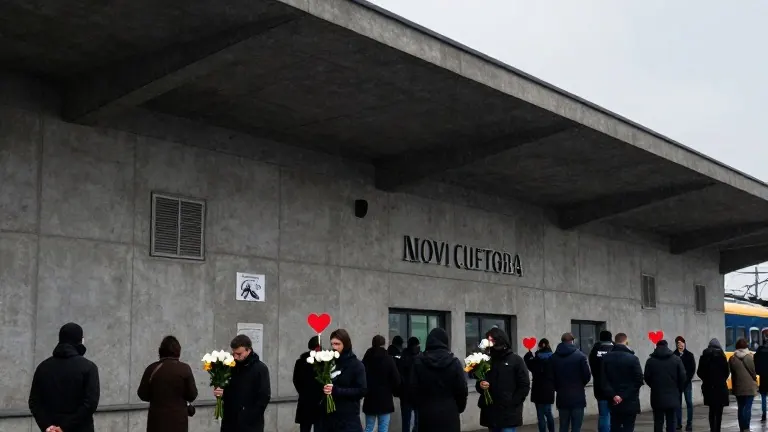
Thousands of residents gathered in Novi Sad, Serbia, on Sunday to mark the second anniversary of a concrete canopy collapse at a train station that killed 16 people. The event coincided with a parliamentary election victory for a student-led coalition that defeated the long-ruling Serbian Progressive Party (SNS) of Prime Minister Aleksandar Vucic. The memorial served as a public assertion that the recent political shift was driven by demands for accountability regarding the 2024 tragedy.
The structural failure occurred on November 1, 2024, at 11:52 a.m. A large concrete structure on the exterior wall of the Novi Sad station fell without warning, crushing people waiting for trains on a sunny autumn day. Fourteen individuals died at the scene, and two others succumbed to their injuries later. One young woman survived with life-altering injuries. The disaster exposed what many citizens viewed as systemic failures in state infrastructure projects.
Protesters carried 16 flower crowns and 16 red hearts to the station exterior, one for each victim. The list of names included children. Participants observed a minute of silence and placed flowers and candles at the site. Unlike the first anniversary, which saw massive crowds under a different political climate, this year’s march proceeded in silence and rain. Organizers said the mood reflected a growing confidence that those responsible for the disaster would face legal consequences.
The collapse of the canopy has been linked to flawed renovation work. An independent investigation by a group of experts concluded that construction standards were systematically degraded. The report stated that the State of Serbia violated the right to life of its citizens. The experts found that political orders had accelerated the renovation work. The station renovation was part of a larger railway reconstruction project involving China and neighboring Hungary. Vucic and his political ally, former Hungarian Prime Minister Viktor Orban, toured the renovated station in 2022.
The student movement that emerged from the tragedy has positioned itself as the primary force against corruption. Since the election defeat of the SNS, students have demanded a review of high-profile investigations, including the case related to the canopy collapse. Thirteen people, including one government minister, were previously charged in the case, but no trial took place as the investigation stalled. The student coalition has pledged to restore the rule of law and democracy, claiming that corruption thrived under Vucic's 14-year tenure.
Legal actions against officials intensified on Sunday. Prosecutors ordered the 48-hour detention of Marko Kricak, the head of Vucic's criminal police. Another senior officer was also detained. Both are suspected of abuse of office in relation to an investigation into a homicide. Kricak has faced additional accusations of orchestrating violence during student protests and threatening a female student with sexual assault. Kricak has denied these personal accusations.
Andreas von Beckerath, the head of the European Union mission in Serbia, commented on the anniversary. He wrote on X that the collapse shook Serbia to its foundations and mobilized citizens across the country to demand transparency. Von Beckerath added that the memory of the victims should inspire a Serbia built on solidarity, public trust, and the rule of law.
State television RTS broadcast the Sunday commemoration. This was a change from the previous year, when Vucic was still in power. The broadcast followed the resignation of several executives from the channel after the recent elections. Memorial ceremonies also took place in other cities and towns throughout Serbia.
The station collapse became a symbol of the fight for legality in Serbia. Authorities initially stated the canopy had not been renovated and promised an investigation. Protests began almost immediately, with citizens blocking traffic nationwide at the exact time of the collapse to demand justice. Some of the rallies organized by young people over the past two years were among the largest anti-government protests in Serbian history.
Source: Greenwich Time