Sacred Writing: The Shift from Reed to Quill in Torah Production
While early Jewish texts favored reeds for their symbolic humility, modern scribes rely on feather and synthetic points to ensure halachic precision.
By Naomi Tesfaye ·
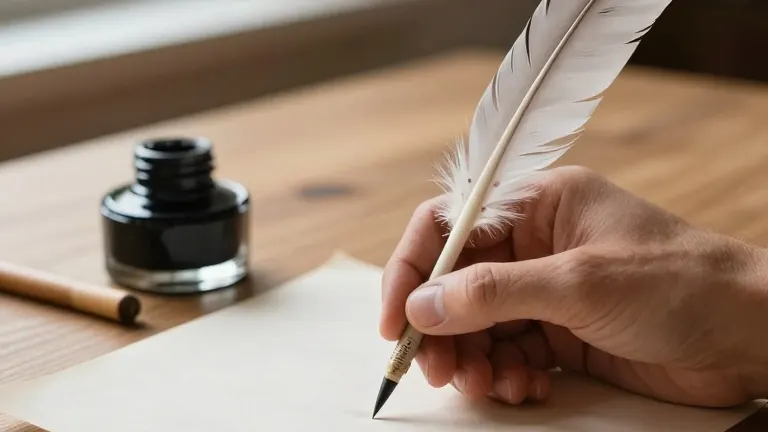
The instrument used to inscribe a Sefer Torah, tefillin, or mezuzah is not merely a tool of craft; it is a vessel for spiritual intention. The choice between a reed, a feather, or a metal point determines the physical form of the letters and their validity under Jewish law.
The tradition began with the reed. The Gemara in Ta'anis 20b teaches that a person should be soft like a reed rather than hard like a cedar. Because of this flexibility, the reed earned the merit of becoming the kulmus, the writing instrument used for sacred texts. Early authorities associated this material with humility and the ability to bend without breaking identity.
As time passed, the reed lost its dominance. The Rema in Yoreh Deah 271:7 cites the view that a Sefer Torah should be written with a reed. However, later generations of scribes, known as sofrim, increasingly adopted feather quills. The Aruch HaShulchan in Yoreh Deah 271 explains that by his time, most scribes no longer had the proficiency to use reeds effectively. Instead, they used feathers from kosher birds, which offered superior control.
The shift to feathers reflects a balance between symbolic tradition and practical craftsmanship. A feather can be cut to a precise edge and reshaped as it wears, becoming an extension of the scribe's hand. This precision is vital because the instrument directly affects the kashrus of the text. If a tool slips, cuts too deeply, or spreads ink poorly, the resulting letters may fail to meet halachic standards.
Later authorities also examined the use of metal pens. The Aruch HaShulchan raised concerns about iron, noting that a sharp iron point can damage parchment. He also highlighted the symbolic association of iron with instruments that shorten life, contrasting this with Torah, which is described as Toras Chaim, a Torah of life. This contrast mirrors the prohibition against using iron on the stones of the Mizbe'ach.
Modern scribes now have access to synthetic and ceramic-style points designed to maintain a consistent edge. These materials offer durability without the traditional drawbacks of reeds or the symbolic concerns of iron. The central question for the sofer remains the same: whether the instrument allows for the creation of proper, beautiful, and durable writing in accordance with halacha.
The evolution from reed to quill to synthetic point illustrates a continuous effort to bridge craftsmanship and kedusha. While the material changes, the purpose remains fixed. The instrument serves to transform a physical stroke of ink into a letter of Torah, maintaining the boundary between the mundane and the sacred.
Source: The Jewish Press