Israel's Finance Minister Proposes 40 New Settlements in Naqab
Bezalel Smotrich's plan to add one million Jewish residents to the Naqab and northern Israel intensifies pressure on the region's Palestinian communities ahead of Tuesday's general election.
By Julia Wang ·
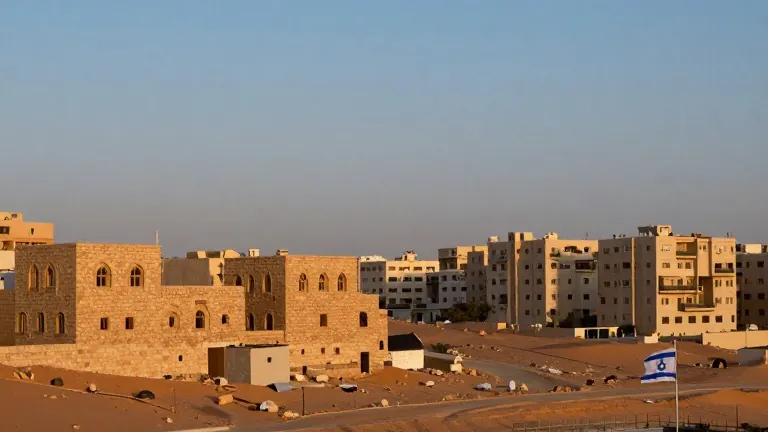
Finance Minister Bezalel Smotrich announced a plan to establish 40 new settlements in the Naqab and northern Israel. The proposal, unveiled in August, aims to add one million Jewish residents to these regions. It includes the creation of dozens of farms and hundreds of thousands of new housing units. This expansion extends the model of territorial control from the occupied West Bank into areas where Palestinian communities are concentrated.
Israel's general election is scheduled for October 27. Prime Minister Benjamin Netanyahu faces opposition led by former general Gadi Eisenkot. Palestinian citizens of Israel make up 20 percent of the population. They face a distinct challenge in this vote. As the political mainstream shifts to the far right, these voters perceive growing threats to their political and collective rights.
Communities in the mixed cities of Jaffa and Lydd have seen an increase in religious-nationalist settler groups since 2021. The process of encroachment accelerated after October 2023. Smotrich's specific target for this expansion is the Naqab, where Palestinian populations are dense. The plan seeks to alter the demographic balance through rapid settlement and land seizure.
National Security Minister Itamar Ben-Gvir is expanding the state's policing capacity. He issued 300,000 gun licenses since taking office. This move widens access to personal firearms for civilians. Ben-Gvir is also developing the role of the National Guard, a force established to handle mass unrest. The guard's framework is still under development, but its potential deployment against protests in Palestinian towns raises questions about civil liberties.
The United Arab List, led by Mansour Abbas, supports the anti-Netanyahu camp. The party argues that parliamentary participation helps remove the far right from power. However, the party's record in the 2021 coalition government complicates this argument. That coalition excluded Netanyahu but failed to enact fundamental changes for Palestinian citizens. The government proved fragile due to deep ideological contradictions among its members.
Mazen Ghnaim, a member of Ra'am, acknowledged in 2022 that he could not push through policies benefiting the Palestinian population. This occurred despite his party being part of the ruling coalition. He also noted the heavy criticism he faced while visiting Palestinian communities. This experience illustrates the difficulty of sustaining political participation within a government that maintains exclusionary nationalist policies.
Palestinian citizens have held Israeli citizenship since 1952. Martial law, which was lifted in 1966, previously governed their lives. Despite formal citizenship, they face discriminatory laws and systemic underfunding of basic services. The state has often relied on criminal networks to enforce control rather than using direct violence. Organised crime groups have obtained advanced weapons, reportedly stolen from army stockpiles or smuggled across borders. This has led to killings, shootings, and arson in Palestinian communities.
The state's approach involves the confiscation of land and the regulation of education and culture. This process promotes the identity of the 'Arab Israeli' as separate from their Palestinian national context. The current political shift embeds these practices in social attitudes. The election on Tuesday offers a choice between Netanyahu's bloc and Eisenkot's opposition. For Palestinian voters, the decision involves weighing the immediate threat of far-right rule against the limited prospect of policy reversal.
The anti-Netanyahu bloc does not offer a clear path to reversing the current trajectory of dispossession. Palestinian political leaders must embrace the connection between their fate and that of the wider Palestinian population. Electoral participation must be accompanied by a radical political response. This includes reforming the High Follow-Up Committee for Arab Citizens of Israel. The goal is to root the organization more firmly in Palestinian society through popular committees and grassroots organizing.
Voting may slow the project of recolonization but cannot reverse the deeper transformation in Israeli society. The cultural shift toward fascism is becoming embedded in everyday life. Another four years of far-right rule would pose an immediate threat to Palestinian communities. The election results will determine the government's approach to the 40 new settlements and the expansion of policing powers in Palestinian towns.
Source: Al Jazeera