UAE Official Warns Military Fixes Will Not End Iran Conflict
Gulf states face a difficult choice between diplomatic talks in Qatar and the risk of another wave of strikes from Tehran.
By Adrian Kovalenko ·
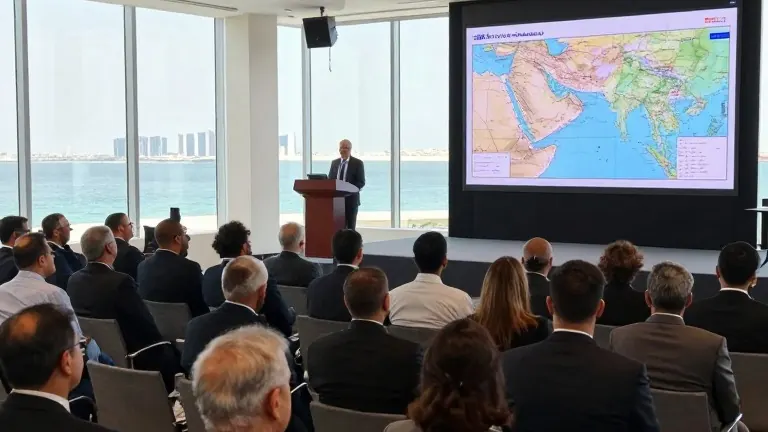
Anwar Gargash, the presidential adviser for the United Arab Emirates, delivered a blunt warning to security leaders in Manama, Bahrain, on Sunday. He stated that military solutions would not provide a quick exit from the current crisis with Iran. Instead, he argued that using force would only complicate an already tangled regional situation.
The conflict began on February 28 with joint strikes by the United States and Israel. Iran retaliated with attacks on Gulf nations. Gargash described the past year as a watershed moment for the region and the world. He emphasized that his country hopes for a diplomatic breakthrough to avoid a new round of confrontation.
Iranian negotiators are currently in Qatar discussing a proposal to reopen the Strait of Hormuz. Foreign Minister Abbas Araghchi said no direct talks are being held with the U.S. He noted that the final outcome depends on answers Washington provides to specific Iranian questions. Araghchi expressed hope that the U.S. would choose diplomacy over other paths, while stating Iran is ready for both defense and diplomacy depending on Washington’s rationality.
The atmosphere at the three-day Manama Dialogue, organized by the International Institute for Strategic Studies, was heavy with concern over possible escalation. Gargash said the crisis requires political tools and wisdom. He acknowledged that the stances of the U.S. and Iran are far apart. If those positions are not bridged, he said the region must worry about the worst.
Other officials shared this sentiment. Egyptian Foreign Minister Badr Abdelatty warned that a second round of escalation would be more dangerous and destructive. He said it would lead to nowhere. Bahraini Foreign Affairs Minister Abdullatif bin Rashid Al Zayani said his country welcomes every effort to reduce tensions and create opportunities for dialogue.
According to the IISS, the UAE faced the largest number of airborne attacks from Iran before the April ceasefire. More than 3,000 drone and ballistic missile attacks targeted airports, military bases, and oil facilities. Most were intercepted. Since the fighting began, Gulf nations have spent billions of dollars to boost their defense capabilities. Iran also fired 500 drones and nearly 200 ballistic missiles toward Bahrain, striking the naval base, residential buildings, and a water desalination plant.
Gargash criticized the lack of a coordinated defense response among the six-member Gulf Cooperation Council. He noted that during the height of the war, each nation worked independently with U.S. command centers. This approach sometimes hindered the overall defensive effort. Gargash said the region has not collectively risen to the challenge, even though each state acted independently or through bilateral cooperation.
The war has solidified U.S.-UAE relations, making them more important to the UAE’s ability to defend itself, Gargash said. He added that it is not in the interest of the region or Iran to withstand another round of war. The forum concluded with officials agreeing that the region is braced for the possibility of escalation if diplomatic talks in Qatar fail to produce a lasting agreement.
Source: Greenwich Time