Trump's Rally Tour and Approval Polls Shape New England Midterm Outlook
As polls open in New England, the president's recent rallies and low approval ratings are influencing how regional candidates campaign and how voters assess the national mood.
By Julia Wang ·
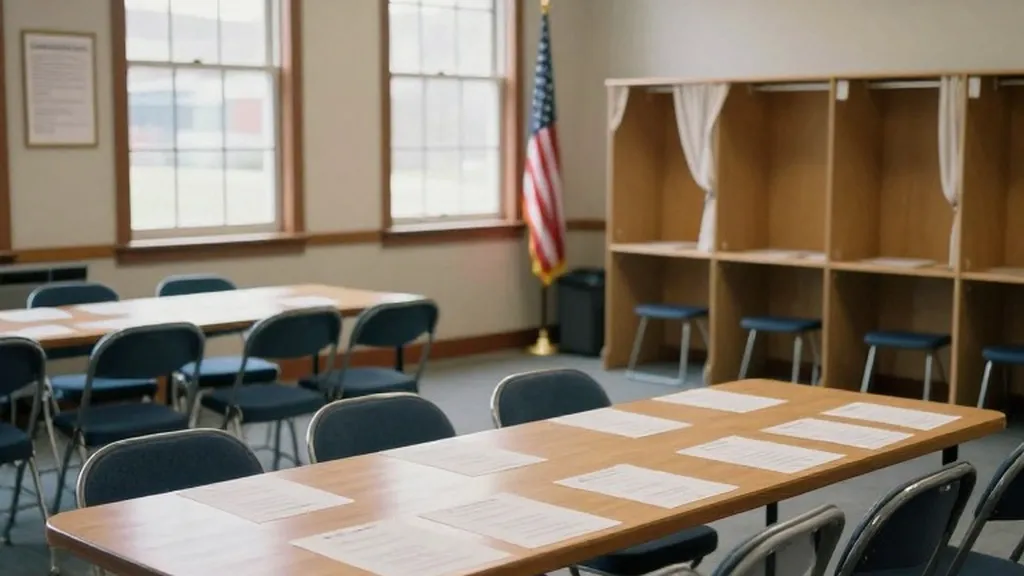
Voters across New England are casting ballots on Tuesday, November 3, 2026, in a midterm election that serves as a referendum on President Donald Trump's second term. The Associated Press notes that many voters are struggling with high prices and are angry over an unpopular war with Iran. In Massachusetts, Rhode Island, and Maine, polls are open from 7 a.m. to 8 p.m. local time. In New Hampshire, opening and closing times vary by municipality, with polls open by 11 a.m. and closing no earlier than 7 p.m. In Vermont, polls open between 5 a.m. and 10 a.m. and close at 7 p.m.
The president has been a central figure in the campaign, holding dozens of rallies in the days leading up to the election. His schedule included stops in Mississippi, South Carolina, and Texas, ending on Sunday in Salina, Kansas. At that final rally, Trump told supporters, "I really want you to pretend I'm on the ballot." This message underscores the high visibility he has maintained despite not being a candidate himself. The Associated Press reports that many Republican candidates have kept their distance from the president during this period, attempting to maintain a distinct identity in their own races.
Public opinion data provides context for the current political climate. An Associated Press-NORC poll indicates that 35% of U.S. adults approve of Trump's job performance. His approval rating for handling the economy stands at 25%. Approximately seven in ten adults say the country is heading in the wrong direction, with most blaming the president for high prices. These figures suggest a challenging environment for Republicans, who are bracing for potential losses in the House of Representatives while fighting to hold the Senate.
In New England, the stakes are significant for both parties. In Massachusetts, voters are deciding on the Senate seat held by incumbent Edward J. Markey and the governor's office held by incumbent Maura Healey. In Rhode Island, the Senate seat is held by incumbent Jack Reed, while the governor's office is an open seat following the primary loss of Daniel McKee. In New Hampshire, the Senate seat is open following the retirement of Jeanne Shaheen, and the governor's office is held by incumbent Kelly Ayotte. In Vermont, incumbent Phil Scott is seeking re-election as governor, with no Senate race on the ballot. In Maine, incumbent Susan Collins is running for re-election in the Senate, and the governor's office is an open seat.
The Associated Press describes the election as a moment where one or two seats could tip either chamber of Congress. Republicans currently hold 53 Senate seats, while Democrats hold 45, plus two independents who caucus with Democrats. Democrats need a net gain of four seats to secure a majority, whereas Republicans can lose only two. In the House, Republicans hold 218 seats and Democrats 214, with one independent. Democrats need a net gain of three districts to take control, while Republicans can lose no more than two. The Associated Press notes that 21 Democratic-held House districts voted for Trump in 2024, adding complexity to the race for the lower chamber.
Trump has continued to make claims about voting fraud, including assertions that noncitizens vote in large numbers. His administration has filed lawsuits in Alaska and California related to voting certification and ballot handling. A federal judge temporarily barred the administration from carrying out a plan to prevent noncitizen voting, while another judge ordered the administration to stop demanding that California election officials segregate ballots cast by people on lists of suspected noncitizens. These legal actions have raised concerns among Democrats about potential interference and intimidation of local election officials.
Financial dynamics are also shaping the election. The 2026 elections are likely to be the most expensive in history. Republican committees have outraised and outspent Democratic committees, aided by Trump-affiliated groups and Elon Musk. However, at the candidate level, Democrats have outraised their opponents. An Associated Press analysis of AdImpact data shows that 88.1% of Republican general election TV ad spending went to states and districts that Trump won in 2024. This includes more than $850 million in spending in areas where he won by 10 points or more.
Local reactions in New England reflect the national mood. In a recent Associated Press report, voter Mark Barker of Palm Beach Gardens, Florida, stated, "I've just been following Trump the whole time. I really think he's doing an awesome job." In contrast, voter James Moore, a 57-year-old librarian in Raleigh, North Carolina, said, "I'm paying more taxes. I'm paying more for my healthcare. I'm paying more for everything." These sentiments mirror the economic concerns driving the election, with high prices and cost of living issues at the forefront for many voters.
The U.S. Postal Service has added hours, staff, and special lines to ensure mail ballots are counted on time. In Vermont, where voting is largely by mail, these logistical adjustments are particularly important. In New Hampshire, the variation in poll hours by town requires voters to check local times. In Maine, small towns may open later than the standard 6 a.m. start time. Voters in all five New England states are entitled to vote if they are in line when polls close, according to USA.gov guidelines.
Republican National Committee Chairman Joe Gruters stated, "Everything depends on turnout. If we turn out our voters, we win, and that's what we've been planning for." Democratic Congressional Campaign Committee Chair Suzan DelBene countered, "The American people are angry. They want change." As polls open and close across the region, the interplay between Trump's influence, economic anxiety, and party strategy will determine the outcome of the midterm elections.